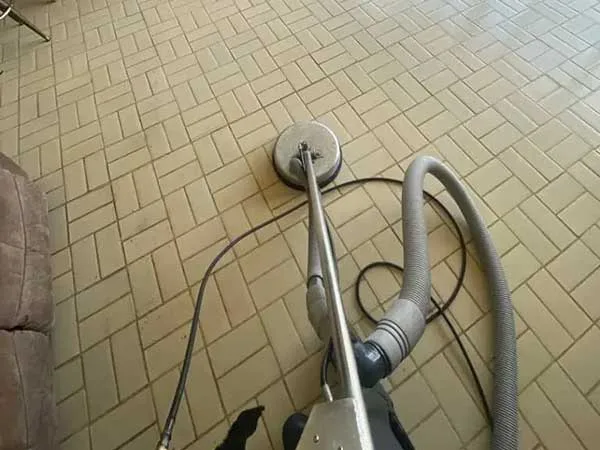
You mop the floor. It dries. And somehow it still looks dull — maybe even worse than before you started. If that sounds familiar, your slate floor isn’t broken. But the way it’s being cleaned probably is.
Slate has a texture and chemistry that most household cleaners aren’t built for. What works fine on ceramic tile can leave a residue on slate that actually attracts more dirt over time. And if you’ve ever grabbed something with vinegar or a citrus base because it seemed “natural,” there’s a real chance it’s already done some damage.
Here’s what’s actually going on with your floor — and what it takes to fix it properly.
What Makes Slate Floor Cleaning Services Different From Regular Tile
Slate is a metamorphic rock that forms in layers, which is exactly what gives it that distinctive textured surface — what’s called a cleft finish. Those natural ridges and fissures are part of what makes slate beautiful. They’re also what makes it a nightmare to clean with standard methods.
When you mop slate with dish soap or a general-purpose floor cleaner, the surfactant in those products doesn’t fully rinse away. It settles into the low points of the stone’s texture, builds up over time, and becomes a dirt trap. The floor starts looking dull almost immediately after cleaning — not because it’s dirty, but because the residue itself is grabbing new grime every time someone walks across it.
That’s the cycle most slate owners are stuck in without realizing it.
Why Household Cleaners Permanently Damage Slate
The texture problem is one thing. The chemistry problem is another — and it’s the one that causes lasting damage.
Slate is sensitive to both acidic and strongly alkaline cleaners. That rules out a surprising number of products that seem perfectly reasonable to grab. Vinegar is probably the most common offender. It’s marketed as a safe, natural cleaner, and for some surfaces it is. On slate, it’s genuinely harmful. The acid etches the stone’s surface, breaks down the protective sealer, and leaves behind dull patches that don’t buff out. Lemon-based cleaners do the same thing. Bleach, on the other end of the pH scale, causes its own set of problems.
What slate actually needs is a pH-neutral cleaner — ideally one formulated specifically for natural stone, not one that just says “safe for all floors” on the label. The difference matters because purpose-built stone chemistry is designed not to leave residue, not to attack the stone’s minerals, and not to strip the sealer prematurely. That last part is important: slate is porous, and the sealer is what keeps spills and staining on the surface rather than soaking in.
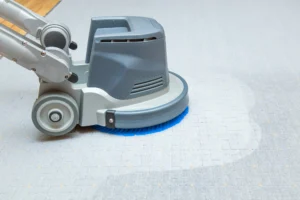
Here’s where it gets tricky for the average homeowner. Even if you find a pH-neutral product, applying it correctly on cleft-finish slate is a different challenge than mopping smooth ceramic. The texture means dirty water doesn’t lift cleanly — it gets pushed around. Professional equipment uses extraction to actually pull contaminants out of those fissures rather than just redistributing them. That’s the mechanical difference between professional stone floor cleaning services and a DIY approach, and it’s why floors that have been mopped for years can still have years of embedded buildup that a single professional service removes in one visit.
The damage from acidic cleaners, though, is a different story. Etching is permanent. It changes the surface of the stone at a structural level, and once it’s there, the only way to address it is through honing — a process that physically removes a thin layer of the stone to get back to undamaged material. That’s a significantly more involved and costly service than routine cleaning. Catching the problem before it gets to that point — or stopping the wrong cleaners before any damage is done — is always the better outcome.
How Professional Slate Floor Cleaning Works
Professional slate floor cleaning isn’t just mopping with better equipment. It’s a multi-step process that starts with identifying the stone and its condition before anything is applied.
The first step is surface assessment — understanding whether the slate has a smooth or cleft finish, whether it’s been sealed, what kind of sealer was used, and what the current level of soiling looks like. That assessment drives every decision that follows: which cleaning chemistry to use, how long to let it dwell, how much agitation the surface can handle, and whether sealing is needed after the clean.
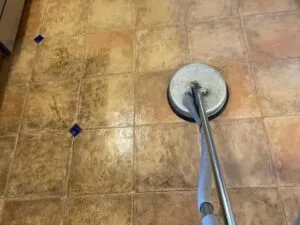
From there, we apply a pH-neutral or mild-alkaline stone-specific cleaner and give it proper dwell time — long enough to break down embedded oils, soap residue, and grime without sitting so long it affects the stone. Then comes extraction, which is where the real difference shows up. Rather than pushing dirty water around, professional extraction equipment pulls it out of the stone’s texture, taking the contaminants with it. On cleft-finish slate, this is the only method that actually works. Mopping, even with the right product, can’t reach what’s settled into those low points.
After cleaning, sealing is often the next conversation. Slate is porous, and a good penetrating sealer creates a barrier that makes future spills easier to manage and slows the rate at which the stone re-soils. It doesn’t make the floor maintenance-free, but it meaningfully extends the time between professional cleanings. For most residential slate floors in Ventura County, professional cleaning once a year is a reasonable baseline — more frequently in high-moisture areas like bathrooms, where mold and mildew in the grout lines can become a real issue faster than most homeowners expect.
One thing worth knowing: after a professional clean, the floor is walkable immediately. The grout lines stay damp for a few hours, but there’s no lengthy dry time that keeps you out of a room for the rest of the day.