
If your travertine floors look dull no matter how much you clean them, you’re not imagining it — and you’re probably not doing anything wrong. Travertine is porous limestone, and it behaves differently from ceramic tile, hardwood, or vinyl. What works on those surfaces can quietly destroy this one.
Ventura County homes are full of travertine — in entryways, kitchens, bathrooms, and on outdoor patios — and a lot of it is being cleaned with products that are slowly causing permanent damage. This page covers what’s actually happening to your stone, how professional cleaning and restoration works, and what to look for when you’re ready to bring someone in.
Travertine Tile Cleaning: Why It’s Not the Same as Cleaning Regular Tile
Travertine is calcium-based limestone. That matters because calcium reacts with acid — and a surprising number of common household cleaners are acidic. Vinegar, lemon-based products, bleach, Windex, and even some dish soaps can chemically etch travertine, leaving permanent dull spots that no amount of mopping will reverse. The damage isn’t on the surface. It’s in the stone itself.
Beyond the chemistry problem, travertine is also porous. Dirt, grease, soap scum, and hard water minerals don’t just sit on top — they work their way into the stone over time. By the time your floors look visibly discolored or dull, the contamination has usually been building below the surface for months or years. Surface cleaning alone won’t reach it.
Travertine Cleaning and Sealing: What the Process Actually Looks Like
Professional travertine cleaning starts with identifying what you’re actually dealing with. Not all travertine is the same — filled and unfilled varieties have different maintenance needs, and polished, honed, and tumbled finishes each respond differently to cleaning chemistry and technique. Before any product goes on your floor, the surface type and condition need to be assessed.
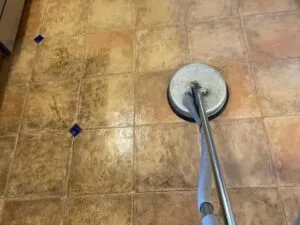
Once the surface is identified, the cleaning process typically involves a pre-treatment to break down embedded contaminants, mechanical agitation to loosen what’s worked its way into the stone, and high-pressure hot water extraction to pull everything out. The goal is to clean below the surface, not just wipe the face of the tile.
After cleaning, sealing is the step most homeowners either skip or underestimate. A penetrating (impregnating) sealer works by soaking into the stone and creating a barrier below the surface — it doesn’t sit on top like a topical coat. This is important because a topical sealer will eventually peel, cloud, or trap dirt underneath it. A properly applied penetrating sealer makes the stone significantly more resistant to staining and moisture absorption without changing its appearance.
How do you know if your travertine needs resealing? Pour a small amount of water on the surface. If it beads up, the sealer is still working. If it soaks in, it’s time. Most professionals recommend resealing every two to four years depending on foot traffic and usage, but in high-traffic areas or homes with pets and kids, more frequent attention makes sense.
One thing worth knowing: applying a sealer over a floor that hasn’t been properly cleaned first is counterproductive. You’re essentially locking in whatever contaminants are already in the stone. The cleaning and the sealing have to happen together, in the right order, with the right products.
Travertine Tile Restoration: When Cleaning Alone Isn’t Enough
There’s a difference between maintenance cleaning and restoration. If your travertine has been well-maintained, periodic professional cleaning and resealing is usually all it needs. But if the floors have been neglected for years, cleaned with the wrong products, or have developed etch marks, scratches, or voids — that’s a different conversation.
Travertine restoration involves a more intensive process: grinding down the surface to remove damage, honing to create a uniform finish, polishing to restore sheen, and filling any holes or voids in the stone. Travertine naturally has small pits and cavities, and over time those can expand or collect debris in ways that become visually obvious. Void filling is part of a complete restoration job.
The good news is that most travertine can be restored, even when homeowners assume it’s too far gone to save. Floors that look like they need to be ripped out and replaced can often be brought back with the right process. Dullness, etching, staining, and general wear are almost always addressable through professional restoration rather than replacement.
From a cost perspective, travertine flooring installation runs anywhere from $600 to over $3,000 for a 100-square-foot space. Professional restoration is a fraction of that. For homeowners in Ventura County, CA who are preparing to sell or simply want to protect what they’ve invested in their home, restoration is almost always the smarter financial call.
Need it done for you? Vanpro offers professional travertine cleaning and polishing across Ventura County. Call or text (805) 620-8546 for a free quote.