
Your travertine floors looked great when they were installed. Now they look dull, cloudy, or just tired — and no amount of mopping seems to help. You’ve probably wondered whether you need polishing, some kind of refinishing, or whether it’s finally time to replace them altogether.
That confusion is exactly where most homeowners get stuck. The good news is that the answer usually isn’t replacement. Travertine is more resilient than it looks, and understanding what’s actually causing the damage makes it a lot easier to choose the right fix — and avoid paying for more than you need.
What Travertine Polishing Actually Involves
Polishing isn’t cleaning. That’s the most important thing to understand before anything else. When you mop a travertine floor, you’re removing surface dirt. When you polish it, you’re physically smoothing and clarifying the stone itself using diamond abrasive pads — the same principle as sandpaper, but designed specifically for natural stone.
The process works in stages. Coarser diamond pads remove micro-scratches and surface irregularities. Finer pads gradually build up clarity and reflectivity. The final result is a floor that looks smooth and bright — not because it’s been coated with anything, but because the surface has been mechanically restored.
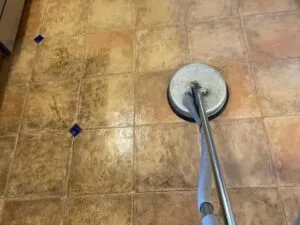
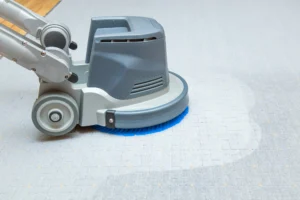
This is why polishing can’t be replicated with a store-bought kit. The machines matter. Large rotary equipment applies consistent, even pressure across the entire floor. Handheld tools don’t — which is why DIY attempts often leave floors with an uneven sheen that looks worse in certain lighting.
The Difference Between Honing and Polishing Travertine
These two terms get used interchangeably, but they describe different stages of the same process — and understanding the difference helps set realistic expectations.
Honing comes first. It uses diamond abrasive pads to smooth the stone surface, removing scratches, etching, and unevenness. The result is a clean, matte or satin finish — no shine yet, but a dramatically more uniform surface. Think of it as the foundation. You can’t build a lasting polish on a surface that hasn’t been properly honed first.
This is why floors sometimes look shiny in one spot and cloudy in another after a DIY polish attempt — the surface wasn’t leveled before the shine was applied.
Polishing follows honing. Finer diamond pads and, in some cases, a polishing powder or paste — typically a combination of oxalic acid and aluminum oxide — work the surface to build reflectivity. The powder works by slightly melting the edges of the micro-scratches left by honing, creating a smoother, more light-reflective surface. The result ranges from a soft satin glow to a high-gloss finish, depending on the stone type and the finish you want.
One important caveat: not every travertine floor is a good candidate for a high-gloss finish. Tumbled travertine, which has a naturally rough, antiqued texture, doesn’t take a mirror polish well. Honed or filled-and-honed travertine responds much better. A professional assessment before any work begins matters here — because applying the wrong process to the wrong finish type produces disappointing results, and sometimes irreversible ones.
After honing and polishing, a quality job always ends with an impregnating sealer. Sealing doesn’t change the look of the floor — it penetrates the stone and protects it from staining, moisture intrusion, and future etching. Without it, the restored surface starts degrading again almost immediately, especially in kitchens and bathrooms where spills are routine.
What’s Actually Causing Your Travertine to Look Dull
Most homeowners assume dullness means the floor is dirty. In reality, the most common cause is etching — and etching isn’t dirt. It’s chemical damage.
Travertine is a calcium-based natural stone, which makes it softer and more reactive than granite or porcelain. When acidic substances come into contact with the surface — citrus juice, wine, vinegar, or even many common household floor cleaners — they react with the calcium carbonate in the stone and dissolve a thin layer of the surface. The result is a dull, whitish mark that looks like a water stain but won’t clean off, because it isn’t a stain. It’s damage to the stone itself.
This distinction matters because no amount of cleaning will fix etching. The damaged layer has to be honed away and the surface rebuilt. Homeowners who keep scrubbing at these spots are wasting time — and potentially making things worse if they’re using acidic cleaners, which continue the etching process with every application.
Scratching is a separate issue. Foot traffic, grit tracked in from outside, and furniture movement all create fine surface scratches over time. In Ventura County, where many homes have travertine in entryways and open-plan living areas that connect to outdoor patios, this kind of wear accumulates faster than people expect. The scratches themselves are usually shallow enough to be addressed with honing and polishing — but only if they haven’t been allowed to deepen over years of use.
A third cause of dullness is mineral deposit buildup. Ventura County’s water supply is notoriously hard — high in calcium and magnesium — and those minerals leave a hazy film on travertine surfaces over time, particularly around sinks, showers, and anywhere water pools. This layer can sometimes be addressed with professional deep cleaning before polishing, but in severe cases it complicates the restoration process.
Need it done for you? Vanpro offers professional travertine cleaning and polishing across Ventura County. Call or text (805) 620-8546 for a free quote.