
Welcome to Vanpro Carpet Cleaning, your locally owned and operated professional carpet & tile cleaning service based in Ventura, CA.
Contact Info
Dull travertine floors and not sure what to do next? Here's how to tell the difference between polishing and refinishing — and why it matters for your Ventura County home.
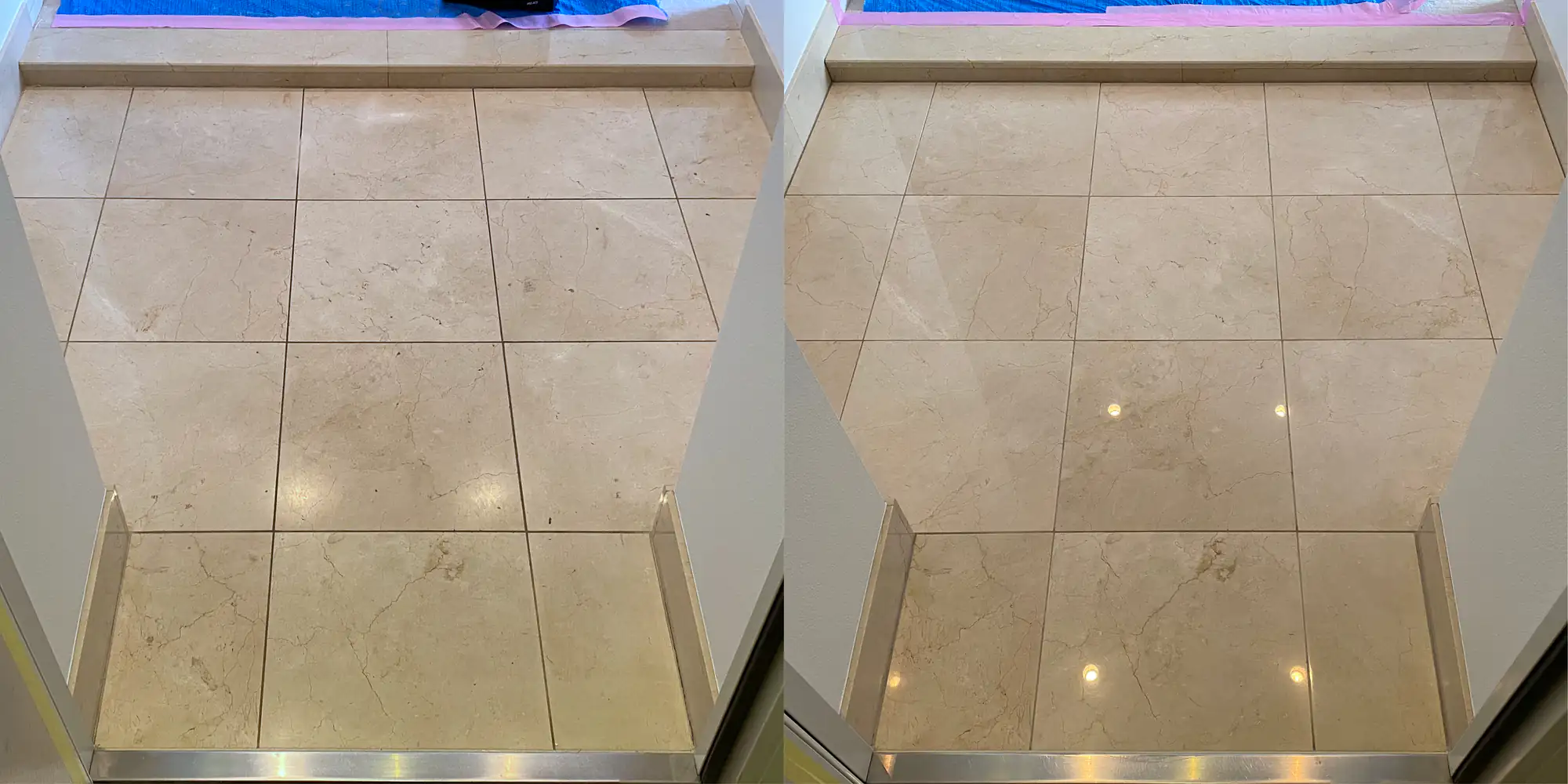
You’ve mopped your travertine floors more times than you can count, and they still look dull. Maybe there’s a hazy patch near the kitchen sink, or the entryway just doesn’t have the sheen it used to. You’ve searched “travertine polishing” and gotten a dozen different answers — some say polish it, some say refinish it, some say hone it first. None of them explain what any of that actually means for your specific floor.
That’s the gap this guide fills. By the time you’re done reading, you’ll know what’s actually wrong with your travertine, which service fixes it, and what a professional process should look like from start to finish.
Most homeowners use “polishing” and “refinishing” interchangeably, and most providers let them — which is part of the problem. They’re related, but they’re not the same thing, and getting the wrong one means paying for a service that doesn’t fix what’s actually broken.
Polishing is a surface-level process. It uses abrasives — either polishing powders, diamond resin pads, or a chemical crystallizer — to restore or enhance the sheen on travertine that’s in reasonably good condition. Refinishing is broader. It typically includes honing the stone down to remove deeper scratches or etching, filling any open voids or pits, and then polishing to restore the finish.
Think of polishing as the final step, and refinishing as the full sequence that leads up to it.
The answer comes down to what’s actually happening on the surface of your stone. Travertine has a Mohs hardness of around 3 to 4 — softer than granite, which sits at 6 to 7. That softness is part of what makes it beautiful, but it also means it picks up damage faster than most homeowners expect.
If your floors look dull or slightly hazy but the surface feels smooth and there are no visible scratches, you’re likely dealing with surface buildup or minor wear that polishing can address. But if you run your hand across the stone and feel rough patches, notice white cloudy marks that appeared after using a common cleaner, or see uneven sheen across the floor, that’s a different story.
Those white hazy patches are almost always acid etching. Acidic substances — vinegar, citrus-based sprays, many standard household floor cleaners — chemically react with the calcium carbonate in travertine and break down the surface. It looks like a stain, but it isn’t. You can’t mop it out. Polishing alone may not be enough if the etching is deep. That’s when honing becomes necessary — and honing is the first step of refinishing, not polishing.
Open pits and holes are another sign. Travertine forms underground near hot springs, and gas escaping through the stone creates natural voids. Those voids are typically filled during manufacturing, but those fillers degrade over time. When they loosen or fall out, you’re left with pitting that polishing won’t fix. Void filling is part of a refinishing process, not a polish.
The honest answer is that diagnosing your floor properly before deciding on a service is the most important step — and it’s something a qualified technician should do in person, not something you should have to guess at from a website.
If you’ve gotten quotes from a few different providers and they all described the process differently, there’s a reason for that. There are three distinct methods used to polish travertine, and which one is right depends on the current condition of your stone.
The first is polishing powder. A powder compound is worked into the surface using a rotary machine, and the friction and mild abrasion bring up the shine. Polishing powders are particularly effective for achieving a deep, high-gloss finish, and they work best either on their own for lightly worn stone or as the final step after honing with diamond pads.
The second method uses diamond resin discs. These pads come in a range of grits — from coarser grits that remove scratches and level uneven spots, down to progressively finer grits that refine the surface before the final polish. This is the method we use when there’s more widespread dullness, visible scratching, or surface irregularities that need to be addressed mechanically before any shine can be restored.
The third method is crystallization. A crystallizer solution is sprayed onto the travertine and worked in using hog hair pads on a rotary machine. The heat and friction cause a chemical reaction that actually hardens the stone’s surface, closes up its pores, and creates a protective shell with a strong shine. The result is a floor that’s not only more reflective but also denser and easier to maintain going forward. It’s a professional-only technique — consumer products can’t replicate it.
Each method has its place. We don’t use the same approach on every floor regardless of condition. The right process starts with an honest look at what the floor actually needs.
Want live answers?
Connect with a Vanpro Carpet Cleaning expert for fast, friendly support.
When a floor needs more than polishing — when there’s real etching, deep scratches, open voids, or significant surface irregularities — refinishing is the right call. The process is more involved, but it’s also the reason a professionally refinished travertine floor can look better than it did when it was installed.
Done correctly, stone refinishing can extend the life of your floor by up to 15 years. That’s not a marketing claim — it’s the practical reality of what mechanical restoration does to a surface that would otherwise keep degrading.
A proper refinishing job follows a defined sequence, and skipping steps is how floors get damaged or fail to hold up after the work is done.
It starts with a thorough inspection — assessing the current finish type, identifying where etching and scratching are concentrated, checking for open voids, and determining what the stone actually needs. This step matters more than most people realize. Travertine comes in honed, polished, brushed, and tumbled finishes, and the restoration approach has to match the original finish or you’ll end up with an uneven result.
Next is deep cleaning with pH-neutral, stone-safe chemistry. This isn’t optional prep — it removes surface soil, residue, and any product buildup that would interfere with the mechanical work. Using the wrong chemistry at this stage, including anything acidic, causes additional etching before the real work even begins.
If the surface has significant scratches, etching, or unevenness, honing comes next. Diamond honing pads in progressively finer grits level the surface and remove damage. This is where the floor gets smooth again — not shiny yet, just smooth.
After honing, any open pits or voids are filled with resin or grout filler matched to the stone. Then comes polishing, using whichever of the three methods — powder, diamond disc progression, or crystallization — is appropriate for the stone and the desired finish.
The final step is sealing. Travertine is naturally porous, and an unsealed surface after polishing will stain and dull quickly. A penetrating sealer goes in after the polish to protect the stone from moisture and spills. Most professionals recommend resealing travertine every 12 to 24 months depending on traffic — more frequently in kitchens or high-use areas, less so in lower-traffic rooms.
If you live in Ventura County and you have travertine, your floors are dealing with conditions that accelerate wear faster than most homeowners expect.
Spanish Colonial and Mediterranean-style homes are everywhere throughout Thousand Oaks, Camarillo, Ojai, and Ventura — and travertine is one of the most common flooring choices in those architectural styles. Entryways, kitchens, bathrooms, and outdoor patios all get it. That’s not a coincidence. It fits the aesthetic. But it also means those floors are working hard.
The outdoor-indoor lifestyle here doesn’t help. When you’re moving between a patio, a pool deck, and interior living spaces regularly, you’re tracking grit and sand across travertine floors constantly. That fine particulate acts like sandpaper underfoot — slowly dulling the surface with every pass. During Santa Ana wind season, the volume of fine grit in the air increases significantly, and it finds its way indoors. Over time, that micro-abrasion adds up.
In coastal areas like Ventura, Oxnard, and Port Hueneme, marine air contributes mineral deposits and surface haze — particularly in bathrooms and showers where moisture is constant. That haze is often mistaken for soap scum or hard water buildup, but on travertine it can involve actual surface degradation that cleaning alone won’t resolve.
The other factor is product damage. Homeowners throughout Ventura County have been sold “natural” or “safe” floor cleaners that are actually acidic — and travertine doesn’t forgive acid. Vinegar-based cleaners are particularly common, and the etching they cause shows up as white hazy patches that look like stains but are actually surface damage. It’s one of the most frequent issues we see on travertine floors across the county, from Simi Valley to Santa Paula to Moorpark.
The good news is that none of this is permanent. Properly diagnosed and professionally restored, travertine floors that look beyond hope can come back looking genuinely new — and with the right sealer and maintenance routine, they stay that way significantly longer than most homeowners expect.
If your floors are dull but smooth, polishing is probably all you need. If there’s etching, visible scratching, open pits, or surface unevenness that persists after cleaning, you’re looking at refinishing — and the sooner it gets addressed, the less work it takes to bring the stone back.
What you shouldn’t do is keep cleaning a floor that has surface damage and expect a different result. Cleaning maintains travertine. It doesn’t restore it. Once the surface is compromised, only mechanical intervention — honing, polishing, sealing — will actually fix it.
If you’re in Ventura County and you’re not sure which category your floors fall into, the right next step is a proper assessment — not a guess. We work with travertine throughout the county, from Thousand Oaks and Camarillo to Oxnard, Ventura, Moorpark, and beyond. We personally evaluate every floor before recommending anything, and the assessment is free. That’s where it starts.
]
Summary:
Article details:
Share:

